
三角関数では、
「sinθ+cosθの値が与えられているときにsinθcosθを求める」
「sinθcosθからsin³θ+cos³θを求める」
といった式の値を求める問題があります。
これらの問題では、単に公式を暗記するのではなく、
・どんな形に式変形すればよいか
・三角関数のどの公式を使えばいいか
といった考え方を理解することが重要になります。
特に、対称式や交代式を利用した式変形や三角関数の相互関係 \(\small \sin^2\theta+\cos^2\theta=1\)をどのように使うかがポイントです。
この記事では、三角関数の式の値を求める問題について、
✓ 対称式・交代式を使った式変形のコツ
✓ よく使う式変形の考え方
✓ 絶対に押さえるべき典型問題パターン2選
をわかりやすく解説していきます。

高校数学の勉強のコツ、日常生活に潜む数学をゆる~く解説した
note記事も更新中!
ぺんきち|公式×思考法で数学力を最大化
数学 / 理科(物理・化学・生物・地学)




三角関数の式の値を求める問題|式変形の考え方と解き方
三角関数の式の値を求める問題には大きく次の3パターンがあります。
・sinθcosθ(積)を求める問題
・sinθ・cosθからなる和を求める問題
例:sin³θ+cos³θなど
・sinθ・cosθからなる差を求める問題
例:sin³θ-cos³θなど
各パターンごとに解き方の考え方を次章で詳しく解説します。
sinθcosθの値の求め方|sin²θ+cos²θ=1の利用
ここでは、sinθcosθ(積)を求める問題の解き方について解説します。
では、具体的な問題を例に解説していきます。
このように、sinθとcosθの和・差の値からsinθcosθ(積)を求める問題が典型パターンになります。
このような問題では、sinθとcosθの和・差の両辺を2乗することでうまく求めることができます。
実際に\(\small \displaystyle \sin\theta +\cos \theta =\frac{1}{2}\)の両辺を2乗すると
\begin{split}
&\small \displaystyle \left(\sin\theta +\cos \theta\right)^2 =\left(\frac{1}{2}\right)^2\\
\small \Leftrightarrow \space &\small \displaystyle \sin^2\theta +2\sin\theta\cos\theta+\cos^2\theta=\frac{1}{4}\\
\small \Leftrightarrow \space &\small \displaystyle \color{#ff0055}1+2\sin\theta\cos\theta=\frac{1}{4} \quad \color{#ff0055}{◀\sin^2\theta+\cos^2\theta=1を利用}\\
\small \Leftrightarrow \space &\small \displaystyle 2\sin\theta\cos\theta=-\frac{3}{4}\\
\small ∴ \space &\small \displaystyle \sin\theta\cos\theta=-\frac{3}{8}\\
\end{split}
このようにsinθとcosθの和・差を2乗することで、
・\(\small \sin^2\theta\)や\(\small \cos^2\theta\)が\(\small \sin^2\theta+\cos^2\theta=1\)によってうまく消える
・sinθcosθの積だけが残る
という点がポイントになります。
例題はsinθ+cosθの場合でしたが、sinθ-cosθの場合も同様に両辺を2乗することでsinθcosθの値を求めることができます。

sin³θ+cos³θの値の求め方|対称式の利用
続いて、sin³θ+cos³θを求める問題の解き方について、具体的な問題を例に解説していきます。
この問題を解くときのポイントは次の2点です。
・sinθとcosθの和(差)からsinθcosθ(積)を求めることができる
・\(\small x,y\)の対称式は基本対称式\(\small x+y\)および\(\small xy\)のみで表すことができる
1点目については、先ほどの例題1で確認した通りです。
2点目については、対称式の公式として、次のような式があります。
・\(\small x^3+y^3=(x+y)^3-3xy(x+y)\)
このように、\(\small x^2+y^2\)や\(\small x^3+y^3\)といった対称式(左辺)は、\(\small x+y\)や\(\small xy\)という基本対称式(右辺)だけを用いて表すことができます。
たとえば、\(\small x+y\)や\(\small xy\)、\(\small x^2+y^2\)などはどれも\(\small x,y\)を入れ替えても元の式と同じになるので対称式です。
逆に、\(\small x-y\)などは、文字を入れ替えると $$\small y-x= -(x-y)$$ となり、元の式 \(\small x-y\)にはならないため、対称式ではありません。
2つの文字\(\small x,y\)において、最も簡単な対称式は
・\(\small x+y\)
・\(\small xy\)
の2つであり、これを基本対称式と呼びます。
では、対称式が基本対称式\(\small x+y\)と\(\small xy\)で表せることが今回のsinθ、cosθの値を求める問題とどう関係してくるのでしょうか?
それは、2点目の文章の\(\small x,y\)をsinθとcosθに置き換えてみると分かります。
\(\small \sin\theta, \cos\theta\)の対称式は基本対称式\(\small \sin\theta+\cos\theta \)および\(\small \sin\theta\cos\theta\)のみで表すことができる。
つまり、sinθとcosθの対称式はsinθとcosθの和と積で求めることができるということになります。
これを1点目の内容と組み合わせると、sinθとcosθの和の値が分かっていれば、積の値を求めることができるため、sinθとcosθの対称式の値を求めることができることが分かります。
このポイントを意識して、実際に例題2を解いてみましょう。
まず、求める式の値 \(\small \sin^3\theta+\cos^3\theta\)は\(\small \sin\theta\)と\(\small \cos\theta\)を入れ替えても同じ式になることから、対称式であることが分かります。
そのため、この式は、sinθとcosθの和と積で表せることになります。
具体的には
$$\small \sin^3\theta+\cos^3\theta=(\sin\theta+\cos\theta)^3-3\sin\theta\cos\theta(\sin\theta+\cos\theta)$$
と表せます。
さて、\(\small \displaystyle \sin\theta+\cos\theta =\frac{1}{2}\)と与えられているため、あとは\(\small \sin\theta\cos\theta\)の値が求められればOKです。
この値は例題1で\(\small \displaystyle \sin\theta\cos\theta =-\frac{3}{8}\)と求めているので、これを代入することで
\begin{split}
&\small \displaystyle \sin^3\theta+\cos^3\theta=\left(\frac{1}{2}\right)^3-3\left(-\frac{3}{8}\right)\cdot \left(\frac{1}{2}\right)\\
\small \Leftrightarrow \space &\small \displaystyle \sin^3\theta+\cos^3\theta=\frac{1}{8}+\frac{9}{16}\\
\small ∴ \space &\small \displaystyle \sin^3\theta+\cos^3\theta=\frac{11}{16}\\
\end{split}
sin³θ-cos³θの値の求め方|因数分解の利用
最後は、sin³θ-cos³θ(sinθとcosθの差)の値を求める問題の解き方について、具体的な問題を例に解説していきます。
一見すると例題2と同じように解けそうですが、sin³θ-cos³θは対称式ではないため、sinθやcosθの和や積だけで表すことができません。
このような場合は、因数分解をしてsinθやcosθの和・差・積などの形で表せないかを確認します。
本問であれば、3乗の差の因数分解の公式を利用することで
\begin{split}
\small \sin^3\theta-\cos^3\theta &\small = (\sin\theta-\cos\theta)(\sin^2\theta+\sin\theta\cos\theta+\cos^2\theta)\\
&\small = (\sin\theta-\cos\theta)(1+\sin\theta\cos\theta)\quad\cdots ①\\
\end{split}
と式変形できます。
①は、sinθ-cosθ(差)とsinθcosθ(積)が含まれた式です。積は例題1で既に求めているので、残りは差を求めればよいことになります。
sinθ-cosθ(差)はこのままだと求めることが難しいですが、差の2乗 \(\small (\sin\theta-\cos\theta)^2\)であればうまく求めることができます。
\begin{split}
\small (\sin\theta-\cos\theta)^2 &\small =\sin^2\theta-2\sin\theta\cos\theta+\cos^2\theta\\
&\small =1-2\sin\theta\cos\theta\\
&\small =1-2\cdot \left(-\frac{3}{8}\right)\\
&\small =\frac{7}{4}\\
\end{split}
これがsinθ-cosθ(差)の2乗なので、求めたかったsinθ-cosθ(差)は
$$\small \displaystyle \sin\theta-\cos\theta=\pm \frac{\sqrt{7}}{2}$$
となります。
ここで、\(\small \displaystyle \frac{\pi}{2} < \theta < \pi\)の範囲では\(\small \sin\theta > \)、\(\small \cos\theta < 0\)のため、\(\small \sin\theta -\cos\theta >0\)となることから
$$\small \displaystyle \sin\theta-\cos\theta=\frac{\sqrt{7}}{2}$$
となります。
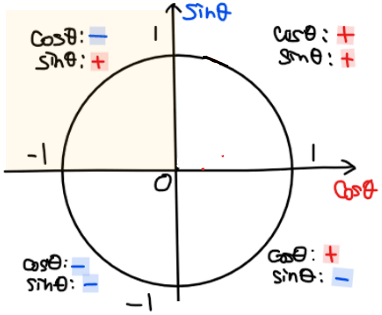
sinθ>0(y軸は正)
よって、①の式に値を代入することで
\begin{split}
\small \sin^3\theta-\cos^3\theta &\small \displaystyle =\frac{\sqrt{7}}{2}\cdot\left(1-\frac{3}{8}\right)\\
&\small \displaystyle =\frac{5\sqrt{7}}{16}\\
\end{split}
と求めることができます。
・\(\small \sin\theta -\cos\theta \)は2乗した値を求めるとうまく計算できる。
三角関数の式の値を求める問題|典型パターンまとめ
ここまで解説した3パターンの解き方を一覧にまとめると以下のようになります。
・sinθとcosθの和・差の式の両辺を2乗して求める。
◆sinθ・cosθからなる和を求める問題
・対称式の公式を用いてsinθ+cosθ(和)、sinθcosθ(積)に分解して求める。
◆sinθ・cosθからなる差を求める問題
・因数分解を利用する。
・sinθ-cosθは2乗した値を求めるうまく計算できる。

三角関数の式の値を求める問題
解説編で確認した3パターンについて、問題演習を通して式変形の考え方が理解できているか確認しましょう。また、やや応用問題(問題3)も載せているので解けるか確認してみましょう。
【問題1】sinθ+cosθからsinθcosθを求める問題
\(\small \displaystyle \cos\theta- \sin\theta=\frac{\sqrt{3}}{2}\)の両辺を2乗することで
\begin{split}
&\small \displaystyle (\cos\theta-\sin\theta)^2=\frac{3}{4}\\
\small \Leftrightarrow \space &\small \displaystyle \color{#ff0055}{\cos^2\theta}-2\sin\theta\cos\theta +\color{#ff0055}{\sin^2 \theta}=\frac{3}{4}\\
\small \Leftrightarrow \space &\small \displaystyle \color{#ff0055}1-2\sin\theta\cos\theta=\frac{3}{4}\\
\small \Leftrightarrow \space &\small \displaystyle -2\sin\theta\cos\theta=-\frac{1}{4}\\
\small ∴ \space &\small \displaystyle \color{red}{\sin\theta\cos\theta=\frac{1}{8}\quad \cdots 【答】}\\
\end{split}
【問題2】sinθ+cosθから式の値(sin³θ+cos³θなど)を求める問題
(1)\(\small \displaystyle \sin\theta-\cos\theta\)
(2)\(\small \displaystyle \sin^2\theta-\cos^2\theta\)
(3)\(\small \displaystyle \sin^3\theta+\cos^3\theta\)
・求める式を2乗したり、対称式の公式を利用したり、因数分解することで、\(\small \sin\theta \), \(\small \cos\theta \)の和・差・積に分解して式の値を求める。
\(\small \displaystyle \sin\theta + \cos\theta = \frac{1}{\sqrt{2}}\)の両辺を2乗すると
\begin{split}
&\small \displaystyle ( \sin\theta + \cos\theta )^2=\frac{1}{2}\\
\small \Leftrightarrow \space &\small \displaystyle \color{#ff0055}{\sin^2\theta}+2\sin\theta\cos\theta +\color{#ff0055}{\cos^2 \theta}=\frac{1}{2}\\
\small \Leftrightarrow \space &\small \displaystyle \color{#ff0055}1+2\sin\theta\cos\theta=\frac{1}{2}\\
\small \Leftrightarrow \space &\small \displaystyle 2\sin\theta\cos\theta=-\frac{1}{2}\\
\small ∴ \space &\small \displaystyle \sin\theta\cos\theta=-\frac{1}{4}\\
\end{split}
ここで、求める値 \(\small \sin\theta- \cos\theta\)の2乗を考えてあげると
\begin{split}
\small (\sin\theta – \cos\theta )^2&\small \displaystyle =1-2\color{#ff0055}{\sin\theta\cos\theta}\\
&\small \displaystyle =1-2\cdot \color{#ff0055}{\left(-\frac{1}{4}\right)}\\
&\small \displaystyle =\frac{3}{2}\\
\end{split}
よって、求めたい値 \(\small \sin\theta – \cos\theta\)は
\begin{split}
\small \sin\theta – \cos\theta &\small \displaystyle =\color{red}{\pm \frac{\sqrt{6}}{2} \quad \cdots 【答】}\\
\end{split}
\(\small \sin\theta – \cos\theta\)をそのまま計算しようとすると式がシンプルすぎて変形のしようがないのですが、2乗を考えることで、\(\small \sin^2\theta, \space \cos^2\theta\)が消えて、\(\small \sin\theta \cos\theta\)の積の形が出てくるため、うまく求めることができます。
\(\small \sin\theta\)と\(\small \cos\theta \)の差の形になっていることから、
$$\small \sin^2\theta- \cos^2\theta = (\sin\theta+\cos\theta)(\sin\theta-\cos\theta)$$
と因数分解することで、sinθとcosθの和と差に分解できるので、(1)の結果を代入することで、
\begin{split}
\small \displaystyle \sin^2\theta- \cos^2\theta &\small \displaystyle =(\sin\theta+\cos\theta)(\sin\theta-\cos\theta)\\
&\small \displaystyle =\frac{1}{\sqrt{2}}\cdot \left(\pm \frac{\sqrt{6}}{2}\right)\\
&\small \displaystyle =\color{red}{\pm \frac{\sqrt{3}}{2} \space ((1)と複号同順)\quad \cdots 【答】}\\
\end{split}
求める式の値 \(\small \sin^3\theta+\cos^3\theta\)は対称式であることから
\begin{split}
\small \displaystyle \sin^3\theta+\cos^3\theta &\small \displaystyle =(\sin\theta+\cos\theta)^3-3\sin\theta\cos\theta(\sin\theta+\cos\theta)\\
&\small \displaystyle =\left(\frac{1}{\sqrt{2}}\right)^3-3\cdot \left(-\frac{1}{4}\right) \cdot \frac{1}{\sqrt{2}}\\
&\small \displaystyle =\frac{\sqrt{2}}{4}+\frac{3\sqrt{2}}{8}\\
&\small \displaystyle =\color{red}{\frac{5\sqrt{2}}{8} \quad \cdots 【答】}\\
\end{split}
【問題3】sinθcosθから式の値(sin³θ−cos³θなど)を求める問題
(1)\(\small \displaystyle \sin\theta+\cos\theta\)
(2)\(\small \displaystyle \sin^3\theta+\cos^3\theta\)
(3)\(\small \displaystyle \sin^3\theta-\cos^3\theta\)
・sinθ、cosθの和や差が求められれば、問題2と同様の方針で式の値を求めることができる。
求める式の値の2乗を考えると
\begin{split}
\small (\sin\theta+\cos\theta)^2 &\small =\sin^2\theta+2\sin\theta\cos\theta+\cos^2\theta\\
&\small =1+2\sin\theta\cos\theta\\
&\small \displaystyle =1+2\cdot \frac{1}{2}\\
&\small =2\\
\end{split}
よって、式の値はこの平方根(2乗する前の数)を考えてあげればよいので、
\begin{split}
& \small (\sin\theta+\cos\theta)^2 =2\\
\small ∴ \space &\small \sin\theta+\cos\theta =\pm \sqrt{2} \\
\end{split}
ここで、\(\small \displaystyle 0 < \theta < \frac{\pi}{2}\)のとき、\(\small \sin\theta > 0\)、\(\small \cos\theta >0\)であることから、\(\small \sin\theta +\cos\theta >0\)となるため、
\begin{split}
&\small \color{red}{\sin\theta+\cos\theta = \sqrt{2} \quad \cdots 【答】}\\
\end{split}
※解き方は問題2(3)と同じです。
\begin{split}
\small \displaystyle \sin^3\theta+\cos^3\theta &\small \displaystyle =(\sin\theta+\cos\theta)^3-3\sin\theta\cos\theta(\sin\theta+\cos\theta)\\
&\small \displaystyle =(\sqrt{2})^3-3\cdot \frac{1}{2}\cdot (\sqrt{2})\\
&\small \displaystyle =2\sqrt{2}-\frac{3\sqrt{2}}{2}\\
&\small \displaystyle =\color{red}{\frac{\sqrt{2}}{2} \quad \cdots 【答】}\\
\end{split}
\(\small \sin\theta\)と\(\small \cos\theta \)の差の形になっていることから、
$$\small \sin^3\theta-\cos^3\theta = (\sin\theta-\cos\theta)(\sin^2\theta+\sin\theta\cos\theta+\cos^2\theta)$$
と因数分解できる。
さらに、\(\small \sin^2\theta+\cos^2\theta=1\)より、上式の右辺は
$$\small \sin^3\theta-\cos^3\theta = (\sin\theta-\cos\theta)(1+\sin\theta\cos\theta) \quad \cdots ①$$
と簡単にできる。
このことから、式の値を求めるには、\(\small \sin\theta\)と\(\small \cos\theta\)の差と積が求められればよい。積に関しては既に問題文で与えられているため、差を求める。
\(\small \sin\theta -\cos\theta\)の2乗は
\begin{split}
\small \displaystyle (\sin\theta-\cos\theta)^2 &\small = \sin^2\theta -2\sin\theta\cos\theta+\cos^2\theta\\
&\small \displaystyle =1-2\cdot \frac{1}{2}\\
&\small \displaystyle =0\\
\end{split}
よって、\(\small \sin\theta -\cos\theta = 0\)と求めることができたので、①の式に代入することで、求める式の値は
\begin{split}
\small \sin^3\theta-\cos^3\theta &\small \displaystyle = (\sin\theta-\cos\theta)(1+\sin\theta\cos\theta)\\
&\small \displaystyle =\color{red}{0 \quad \cdots 【答】}\\
\end{split}
$$\small \sin^3\theta-\cos^3\theta = (\sin\theta-\cos\theta)^3+3\sin\theta\cos\theta(\sin\theta-\cos\theta)$$
の関係式を利用してもよい。

まとめ|パターンごとの式変形の考え方を理解することが重要
今回は、三角関数を含む式の値を求める問題について解説しました。
パターンはいろいろとありましたが、すべての問題に共通する考え方として、『sinθやcosθの和、差、積の形に式変形する』ことがポイントだということが分かったのではないでしょうか?
そのための具体的な方法として、2乗したり、対称式の公式を使ったりといったテクニックについては、問題を解く中で自然と覚えられると思うので、今回紹介した典型問題を繰り返し解き、式変形の方針をマスターしてしまいましょう。
他にも、自分にあった最適な参考書の見つけ方についても 高校数学の参考書の選び方|独学・先取り学習に最適なおすすめ教材を徹底解説 で解説しているので、よければ確認してください!


自分に合ったコスパ・タイパの良い通信教育サービスを、こちらの記事で分かりやすく解説しています。気になる方はぜひチェックしてみてください。
【数学攻略】部活と両立して偏差値を上げる!通信教育3社(スタサプ・Z会・進研ゼミ)を徹底比較
では今回は以上です。お疲れ様でした!


コメント