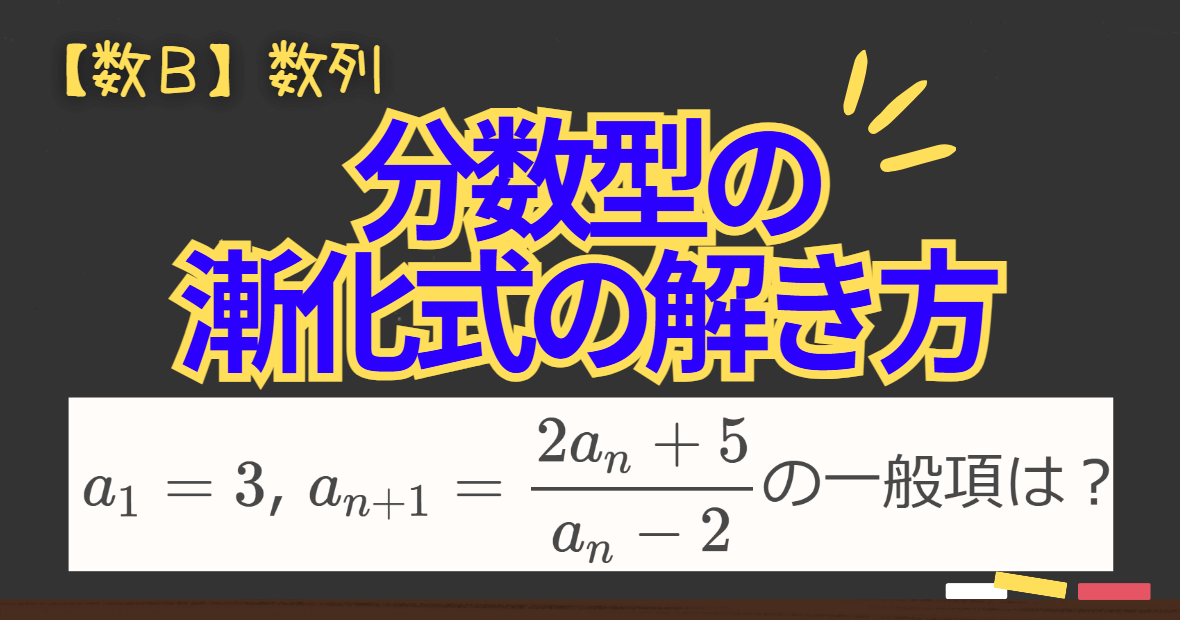
「分数型の漸化式を見ただけで手が止まってしまう……」、「逆数をとるのか、特性方程式で解くのかの見分け方がいまいち分からない…」そんな悩みを持っていませんか?
数学Bの数列において、分数型の漸化式 \(\small \displaystyle a_{n+1} = \frac{qa_n+s}{pa_n + r}\)は、解き方を知らないと正直初見で解くのは難しいでしょう。しかし、攻略法は実はシンプルで、たった2つのアプローチ方法しかありません。
- 「逆数」をとって基本形に持ち込むパターン
- 「特性方程式」を利用して基本形に持ち込むパターン
本記事では、分数型の2つの解法パターンの解説とどちらを使うかの見極め方について、具体的な問題を通して分かりやすく徹底解説します。
「なぜ逆数をとるのか?」「特性方程式はどうやって作るのか?」といった疑問を解消し、苦手な分数型を「得意な得点源」に変えていきましょう。

- 分数型の漸化式を見ただけで「難しそう」と手が止まってしまう人
- 逆数にする解法と特性方程式を使う解法、どちらを使うかの見極め方を知りたい人
- 大学入試や模試に出てくるような漸化式の応用問題まで解けるようになりたい人
高校数学の勉強のコツ、日常生活に潜む数学をゆる~く解説した
note記事も更新中!
ぺんきち|公式×思考法で数学力を最大化
数学 / 理科(物理・化学・生物・地学)





1次分数型・逆数型の漸化式を徹底解説
【問題1】逆数型の漸化式の解き方(難易度:★☆☆)
\(\small a_1= 1\), \(\small \displaystyle a_{n+1}=\frac{a_n}{a_n-3}\)を満たす数列 \(\small \{a_n\}\)の一般項を求めよ。
→\(\small s=0\)の場合は、漸化式の分子部分が\(\small a_n\)のみになるので、逆数をとった数列 \(\small \displaystyle \frac{1}{a_n}\)が基本形の漸化式を満たします。
基本形の漸化式の解き方については、『【漸化式の解き方】特性方程式を利用した解法、等差数列型・等比数列型・階差数列型【漸化式マスターの道①】』をチェックしよう!
漸化式の分子が\(\small a_n\)のみなので、両辺の逆数をとることで
\begin{split}
&\small \displaystyle a_{n+1}=\frac{a_n}{a_n-3}\\
\small \Leftrightarrow \space &\small \displaystyle \frac{1}{a_{n+1}}=\frac{a_n-3}{a_n} \space \color{#ff0055}{◀逆数とる}\\
\small \Leftrightarrow \space &\small \displaystyle \frac{1}{a_{n+1}}=\frac{a_n}{a_n}-\frac{3}{a_n} \space \color{#ff0055}{◀通分の逆}\\
\small \Leftrightarrow \space &\small \displaystyle \frac{1}{a_{n+1}}=1-\frac{3}{a_n}\\
\end{split}
ここで、\(\small \displaystyle b_n=\frac{1}{a_n}\)…①とおくと、
\begin{split}
&\small \displaystyle \color{#ff0055}{\frac{1}{a_{n+1}}}=1-3\cdot \color{#ff0055}{\frac{1}{a_n}}\\
\small \Leftrightarrow \space &\small \displaystyle \color{#ff0055}{b_{n+1}}=1-3\color{#ff0055}{b_n}\\
\small \Leftrightarrow \space &\small \displaystyle b_{n+1}=-3b_n+1 \space \cdots ②\\
\end{split}
②は、\(\small a_{n+1}=pa_n+q\)型であり、漸化式の基本形なので、特性方程式を利用することで解くことができます。
●補足
ここからは、一旦 『\(\small b_{n+1}=-3b_n+1\)の一般項 \(\small b_n\)を求めよ』という問題を解くことを考えていきます!
特性方程式を解くと
\begin{split}
&\small \alpha = -3\alpha +1\\
\small \Leftrightarrow \space &\small 4\alpha = 1\\
\small ∴ \space &\small \alpha = \frac{1}{4}\\
\end{split}
なので、\(\small \displaystyle c_n = b_n-\frac{1}{4}\)…③とおくと
\begin{split}
&\small c_{n+1}=-3 c_n \space \color{#ff0055}{◀等比型の漸化式}\\
\end{split}
となるので、数列\(\small \{c_n\}\)の一般項は、初項 \(\small c_1\), 公比\(\small -3\)の等比数列なので、
\begin{split}
&\small c_{n}=c_1 \cdot (-3)^{n-1} \space \cdots ④\\
\end{split}
初項 \(\small c_1\)は、③, ①の関係式と\(\small a_1=1\)であることから、
\begin{split}
\small c_{1} &\small \displaystyle =b_1-\frac{1}{4} \space \color{#ff0055}{◀③の式}\\
&\small \displaystyle =\frac{1}{a_1}-\frac{1}{4} \space \color{#ff0055}{◀①の式}\\
&\small \displaystyle =1-\frac{1}{4} \space \color{#ff0055}{◀a_1=1を代入}\\
&\small \displaystyle =\frac{3}{4}\\
\end{split}
と求まったので、④に代入することで
\begin{split}
&\small c_{n}=\frac{3}{4} (-3)^{n-1}\\
\end{split}
最後に、③, ①の関係式を使って\(\small a_n\)を求めると
\begin{split}
&\small \displaystyle c_{n} =\frac{3}{4} (-3)^{n-1}\\
&\small \displaystyle \color{#ff0055}{b_{n}-\frac{1}{4}} =\frac{3}{4} (-3)^{n-1} \space \color{#ff0055}{◀③の式}\\
&\small \displaystyle \color{#ff0055}{\frac{1}{a_{n}}}-\frac{1}{4} =\frac{3}{4} (-3)^{n-1} \space \color{#ff0055}{◀①の式}\\
&\small \displaystyle \frac{1}{a_{n}}=\frac{3}{4} (-3)^{n-1}+\frac{1}{4}\\
&\small \displaystyle \frac{1}{a_{n}}=\frac{3\cdot (-3)^{n-1}+1}{4}\\
&\small \displaystyle a_{n}=\frac{4}{3\cdot (-3)^{n-1}+1}\\
&\small \displaystyle \color{red}{a_{n}=-\frac{4}{(-3)^{n}-1} \space \cdots 【答】}\\
\end{split}
●補足
最後の分母の式変形は、\(\small 3\cdot(-3)^{n-1}=-(-3)\cdot (-3)^{n-1}=-(-3)^n\)なので、
\begin{split}
\small \displaystyle \frac{4}{3\cdot (-3)^{n-1}+1} &\small =\frac{4}{-(-3)^{n}+1}\\
&\small =\frac{4}{-\{(-3)^{n}-1\}}\\
&\small =-\frac{4}{(-3)^{n}-1}\\
\end{split}
という式変形をしています。
【研究】他に解き方はないのか
逆数型の漸化式は問題2で解説する「1次分数型」の特殊形(\(\small s=0\)パターン)なので、
詳しくは問題2で解説しますが、1次分数型の解法と同様に
$$\small \alpha = \frac{\alpha}{\alpha-3}$$
の特性方程式の解、\(\small \alpha = 0,4\)を用いて
$$\small b_n = \frac{a_n-4}{a_n} \space \cdots (*)$$
とおくことで
$$\small b_{n+1}=-3b_n$$
を満たすことから、\(\small b_n = (-3)^n\)と求まるので、\(\small (*)\)に代入することで\(\small a_n\)を求めることができます。
ただ、逆数をとる解法の方が計算は楽になります。
【問題2】1次分数型の漸化式の解き方(難易度:★★☆)
\(\small a_1= 3\), \(\small \displaystyle a_{n+1}=\frac{2a_n+5}{a_n-2}\)を満たす数列 \(\small \{a_n\}\)の一般項を求めよ。
$$\small \displaystyle \alpha = \frac{q \alpha+s}{p \alpha+r}$$
の解 \(\small \alpha_1\), \(\small \alpha_2\)を用いて
$$\small \displaystyle \color{#ff0055}{b_n=\frac{a_n-\alpha_1}{a_n-\alpha_2}}$$
とおくと、数列 \(\small \{b_n\}\)は等比型の漸化式を満たします。この\(\small b_n\)の一般項を求めることで、もとの\(\small a_n\)も求めることができます。
分数型の漸化式なので、特性方程式
\begin{split}
&\small \displaystyle \color{#ff0055}{\alpha =\frac{2\alpha+5}{\alpha-2}}\\
\end{split}
を解くことで、
\begin{split}
&\small \displaystyle \alpha =\frac{2\alpha+5}{\alpha-2}\\
\small \Leftrightarrow \space &\small \displaystyle \alpha(\alpha-2) =2\alpha+5\\
\small \Leftrightarrow \space &\small \displaystyle \alpha^2-2\alpha =2\alpha+5\\
\small \Leftrightarrow \space &\small \displaystyle \alpha^2-4\alpha -5 =0\\
\small \Leftrightarrow \space &\small \displaystyle (\alpha+1)(\alpha-5) =0\\
\small ∴ \space &\small \displaystyle \alpha=-1, \space 5\\
\end{split}
と2解が求まりました。
この2解を用いて、
\begin{split}
&\small \displaystyle b_n= \frac{a_n-5}{a_n+1} \space \cdots ①\\
\end{split}
とおくと [*1]、
*1:【補足】特性方程式の2解は\(\small b_n\)の分母・分子のどっちに置く?
特性方程式の解は2つありますが、分母・分子はどちらでもOKです。
なので\(\small b_n\)は
$$\small \displaystyle b_n = \frac{a_n+1}{a_n-5}$$
とおいても解くことができます。
\(\small b_{n+1}\)と\(\small b_n\)の漸化式は
\begin{split}
&\small \displaystyle b_{n+1}= \frac{\color{#ff0055}{a_{n+1}}-5}{\color{#ff0055}{a_{n+1}}+1}\space \color{#ff0055}{◀①でnをn+1に}\\
\small \Leftrightarrow \space &\small \displaystyle b_{n+1}= \frac{\color{#ff0055}{\dfrac{2a_n+5}{a_n-2}}-5}{\color{#ff0055}{\dfrac{2a_n+5}{a_n-2}}+1} \space \color{#ff0055}{◀問題の漸化式を代入}\\
\small \Leftrightarrow \space &\small \displaystyle b_{n+1}= \frac{2a_n+5-5(a_n-2)}{2a_n+5+(a_n-2)} \space \color{#ff0055}{◀分母分子を a_n-2 倍}\\
\small \Leftrightarrow \space &\small \displaystyle b_{n+1}= \frac{-3a_n+15}{3a_n+3}\\
\small \Leftrightarrow \space &\small \displaystyle b_{n+1}= \frac{-3(a_n-5)}{3(a_n+1)}\\
\small \Leftrightarrow \space &\small \displaystyle b_{n+1}= -\frac{a_n-5}{a_n+1}\\
\small \Leftrightarrow \space &\small \displaystyle b_{n+1}= -b_n \space \cdots ②\\
\end{split}
②は、等比型の漸化式であり、公比は\(\small -1\)、初項 \(\small b_1\)は①の式で\(\small n=1\)を代入することで、
\begin{split}
\small b_1 &\small \displaystyle = \frac{a_1-5}{a_1+1} \\
&\small \displaystyle = \frac{3-5}{3+1} \space \color{#ff0055}{◀a_1=3を代入}\\
&\small \displaystyle = -\frac{1}{2}\\
\end{split}
より、数列 \(\small \{b_n\}\)の一般項は
\begin{split}
\small b_n = -\frac{1}{2}\cdot (-1)^{n-1} \space \cdots ③\\
\end{split}
最後に③を①に代入することで \(\small a_n\)を求めていきます。
\begin{split}
&\small \displaystyle b_n = \frac{a_n-5}{a_n+1}\\
\small \Leftrightarrow \space &\small \displaystyle b_n (a_n+1)= a_n-5\\
\small \Leftrightarrow \space &\small \displaystyle (b_n-1)a_n=-b_n-5\\
\small \Leftrightarrow \space &\small \displaystyle a_n=-\frac{b_n+5}{b_n-1}\\
\small \Leftrightarrow \space &\small \displaystyle a_n=-\frac{-\dfrac{1}{2}\cdot (-1)^{n-1}+5}{-\dfrac{1}{2}\cdot (-1)^{n-1}-1} \space \color{#ff0055}{◀③を代入}\\
\small \Leftrightarrow \space &\small \displaystyle a_n=-\frac{-(-1)^{n-1}+10}{-(-1)^{n-1}-2} \space \color{#ff0055}{◀分母分子を2倍}\\
\small \Leftrightarrow \space &\small \displaystyle a_n=-\frac{(-1)^{n}+10}{(-1)^{n}-2} \space \color{#ff0055}{◀-(-1)^{n-1}=(-1)^n}\\
\end{split}
【補足】
\(\small a_n\)を求める際の計算は、①の式に③の結果を代入してから\(\small a_n\)について解いてもよいですが計算が煩雑になるので、はじめに\(\small a_n\)について解いてから③を代入する方が式の整理が楽になっておすすめです!
よって、\(\small \displaystyle \color{red}{a_n=-\frac{(-1)^{n}+10}{(-1)^{n}-2} \cdots 【答】}\).
本記事のまとめ
今回は、分数型の漸化式について2種類の解法を解説しました。それぞれの漸化式の形と解き方をまとめると次のようになります。
| パターン | 漸化式の形 | 解き方 |
|---|---|---|
| 逆数型 | $$\small a_{n+1} = \frac{qa_n}{pa_n + r}$$ | 両辺の逆数をとって、特性方程式型に帰着させて解く。 |
| 1次分数型 | $$\small a_{n+1} = \frac{qa_n + s}{pa_n + r}$$ | 特性方程式 $$\small \alpha = \frac{q\alpha + s}{p\alpha + r}$$ を解き、$$\small b_n = \frac{a_n – \alpha_1}{a_n – \alpha_2}$$ と置くことで、\(\small b_n\)を等比型の漸化式に帰着させて解く。 |
このように分子の形を見て、分子が\(\small qa_n\)のみであれば逆数型、\(\small qa_n+s\)の形であれば、1次分数型のように見分けるようにしましょう。
最後に、応用問題の漸化式を解く際に一番重要なのは『いかに知っている形(基本形)にいかに帰着させるか?』いう視点です。なので、問題ごとに別々で考えるのではなく、『解ける形を増やしていく』+『解ける形に寄せていく』という考え方で式変形するという思考法で解法を整理できるようにしておきましょう。
今回は以上です。お疲れさまでした!

コメント