
三角関数の相互関係は、三角関数の問題を解くうえで特に利用頻度の高い公式です。
今回は、三角関数の相互関係が成り立つことの証明と、さらにその公式を利用して sinθ・cosθ・tanθ の値を求める問題の解き方についてもわかりやすく解説していきます。
高校数学の勉強のコツ、日常生活に潜む数学をゆる~く解説した
note記事も更新中!
ぺんきち|高校数学の図解ノート
数学 / 理科(物理・化学・生物・地学)

三角関数の相互関係とは?
三角関数の相互関係一覧
まずは本記事の本題である三角関数の相互関係の式を確認しましょう。
\(\small \displaystyle [2] \tan \theta =\frac{\sin\theta}{\cos\theta}\)
\(\small \displaystyle [3] 1+\tan^2 \theta =\frac{1}{\cos^2 \theta}\)
公式自体は授業や教科書で見聞きしたことがある人が多いでしょう。
三角関数の相互関係とは、名前の通り三角関数 \(\small \sin \theta \)、\(\small \cos \theta \)、\(\small \tan \theta \)の関係性を表した公式です。
では、なぜ、このような三角関数の相互関係が成り立つのでしょうか?
三角関数の定義|単位円でどう表せる?
三角関数の相互関係を理解するためには、まず「三角関数を単位円でどう表すか」を知っておくことが大切です。
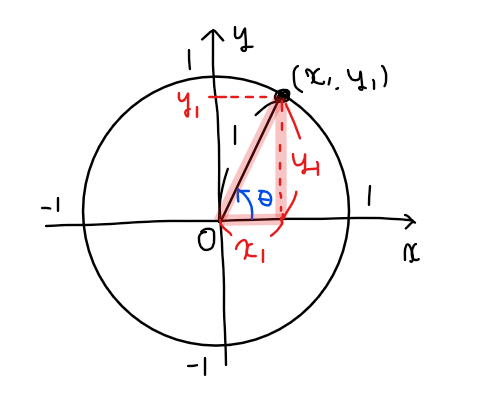
単位円とは、\(\small xy\)平面上にある半径が1の円のことをいいます。
「単位」とは「1」を意味する言葉で、物理などで出てくる「単位時間あたり」という表現を聞いたことがある人も多いかもしれません。
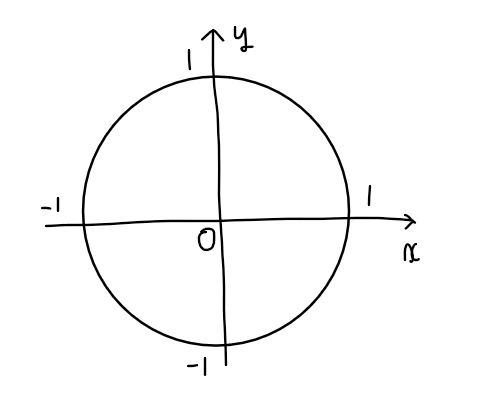
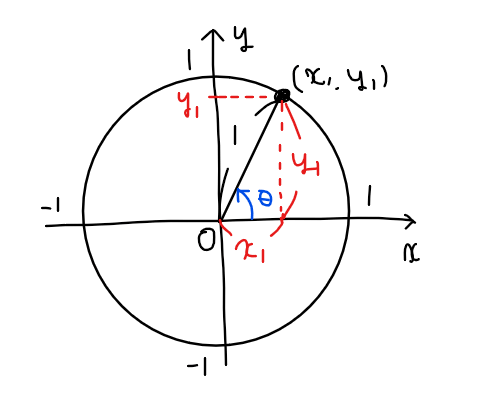
そして、円周上に点\(\small (x_1,y_1)\)を取って、その点と原点を結んだ半径と\(\small x\)軸の正の部分までの角度(反時計回りに計った角度)を\(\small \theta\)とします。
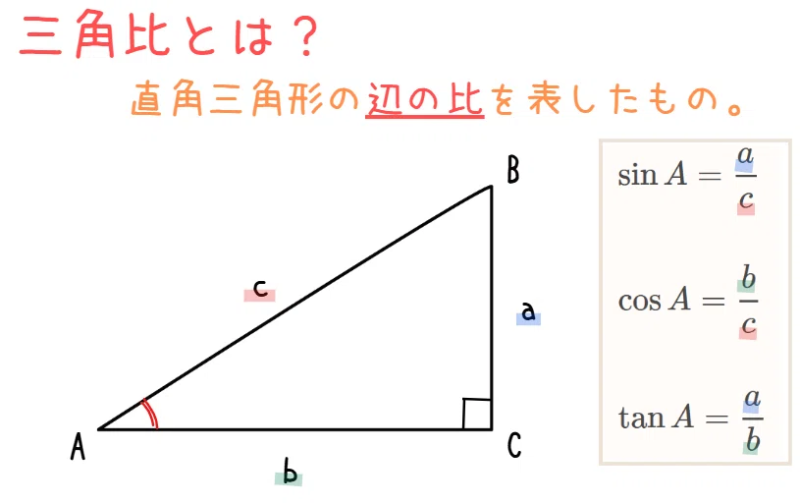
ここで数Ⅰで学習した直角三角形の三角比の定義を思い出しましょう。
この考え方を、単位円にある以下の直角三角形にあてはめて考えると、\(\small \sin \theta \)、\(\small \cos \theta \)、\(\small \tan \theta \)の値はそれぞれ次のように定義できます。
\begin{cases}
\small \displaystyle \sin\theta = \frac{y_1}{1}=y_1 \quad \cdots ①\\
\small \displaystyle \cos\theta = \frac{x_1}{1}=x_1 \quad \cdots ②\\
\small \displaystyle \tan \theta = \frac{y_1}{x_1} \quad \cdots ③\\
\end{cases}
これが三角関数の定義式になります。
実はこの定義式を見れば三角関数の相互関係が成り立つことは意外と簡単に示すことができます。

三角関数の相互関係の証明
では、単位円と先程確認した\(\small \sin \theta \)、\(\small \cos \theta \)、\(\small \tan \theta \)の定義式①~③を使って、三角関数の相互関係が成り立つ理由を解説します。
sin²θ+cos²θ=1の導出
[1] \(\small \sin^2\theta+\cos^2\theta =1\)がなぜ成り立つのか解説します。
まずは、単位円の図にかいた直角三角形に着目しましょう。
すると、三平方の定理から
$$\small (x_1)^2+(y_1)^2=1$$
が成り立ちます。
そして、三角関数の定義式①、②を上式に代入することで
\begin{split}
&\small (x_1)^2+(y_1)^2=1\\
\small \Leftrightarrow \space &\small (\cos\theta)^2+(\sin\theta)^2=1\\
\small ∴ \space &\small \color{#ff0055}{\sin^2\theta+\cos^2\theta=1}\\
\end{split}
これで1つ目の関係式が示せました。
・\(\small (\sin\theta)^2=\sin^2\theta \)
・\(\small (\cos\theta)^2=\cos^2\theta \)
・\(\small (\tan\theta)^2=\tan^2\theta \)
のように表します。
理由は、\(\small \sin\theta^2 \)と表してしまうと、『\(\small \sin\theta\)の2乗』なのか『角度\(\small \theta\)を2乗したサイン(\(\small \sin(\theta^2)\))』なのかが曖昧になってしまうためです。
tanθ=sinθ/cosθの導出
[2] \(\small \displaystyle \tan\theta =\frac{\sin\theta}{\cos\theta}\)がなぜ成り立つのか解説します。
三角関数の定義式の③
$$\small \displaystyle \tan \theta =\frac{y_1}{x_1}$$
の右辺に、①、②を代入すれば
$$\small \displaystyle \tan \theta =\frac{\sin\theta}{\cos\theta}$$
となります。
1+tan²θ=1/cos²θの導出
[3] \(\small \displaystyle 1+\tan^2 \theta =\frac{1}{\cos^2\theta}\)の導出がなぜ成り立つのか解説します。
いよいよ最後の関係式です。
[1]の関係式 \(\small \sin^2\theta+\cos^2\theta=1\)の両辺を\(\small \cos^2\theta\)(≠0とする)で割り算すると
\begin{split}
&\small \displaystyle \frac{\sin^2\theta}{\cos^2 \theta}+1=\frac{1}{\cos^2 \theta}\\
&\small \displaystyle \color{#ff0055}{\tan^2\theta+1=\frac{1}{\cos^2 \theta} \quad ◀示せた}\\
\end{split}
最後の2行目への式変形は、[2]の関係式
\begin{split}
\small \displaystyle \tan\theta=\frac{\sin\theta}{\cos\theta}\\
\end{split}
を利用して、\(\small \displaystyle \frac{\sin\theta}{\cos\theta}\)を\(\small \tan\theta\)にしています。
補足:もう一つ別の導出方法
[3]の関係式の左辺を式変形して右辺になることを示す方法でも証明ができます。
\begin{split}
&\small \displaystyle 1+\color{#ff0055}{\tan^2 \theta\quad ◀\tan\theta =\frac{\sin\theta}{\cos\theta}を利用}\\
&\small \displaystyle =1+\frac{\sin^2\theta}{\cos^2\theta}\\
&\small \displaystyle =\frac{\cos^2\theta}{\cos^2\theta}+\frac{\sin^2\theta}{\cos^2\theta}\\
&\small \displaystyle =\frac{\color{#ff0055}{\cos^2\theta+\sin^2\theta}}{\cos^2\theta} \quad\color{#ff0055}{◀\sin^2\theta+\cos^2\theta=1を利用}\\
&\small \displaystyle =\frac{1}{\cos^2\theta}\\
\end{split}
よって、[3]の(左辺)=(右辺)が示せた。

三角関数の相互関係の覚え方
sin²θ+cos²θ=1の覚え方
三角関数の定義式①、②からもわかる通り、単位円上では、
・『\(\small \sin\theta\)はy座標』
・『\(\small \cos\theta\)はx座標』
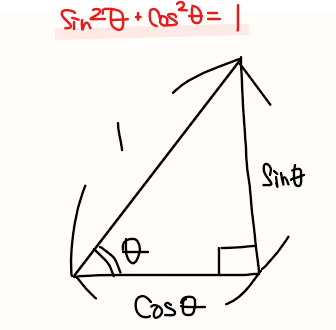
を意味しているので、[1]の関係式は、斜辺1の直角三角形に対して三平方の定理
$$\small \color{#ff0055}{x^2+y^2=1}$$
を言い換えただけと理解するのが覚えやすいと思います。
tanθ=sinθ/cosθの覚え方
\(\small \tan\theta\)の定義式
$$\small \displaystyle \tan\theta = \frac{yの値\space\space\space }{xの値 \space\space\space }$$
に、
・『\(\small \sin\theta\)はy座標』
・『\(\small \cos\theta\)はx座標』
であることを当てはめただけです。
tanθの定義式を言い換えた式と覚えておくのが簡単だと思います。
1+tan²θ=1/cos²θの覚え方
この関係式は三角関数の分野ではあまり利用頻度は高くないです。なので、暗記しつつも、忘れたときに導けるようにしておくことが大事になります。
[3]の関係式は2つの導出方法を紹介しましたが、別解の導出方法は、そもそも[3]の関係式の左辺 \(\small 1+\tan^2\theta\)を覚えている必要があるため、関係式を忘れてしまった場合、導けなくなる可能性が高いです。
そのため、『[1]の両辺を\(\small \cos^2\theta\)でわる』と覚えておくのがシンプルで一番覚えやすいと思います。
三角関数の相互関係の使い方|どんな問題で使う?
三角関数の相互関係は、三角方程式や三角不等式、三角関数の最大・最小を求める問題でよく使われる公式です。
これらの問題を解くときに、複数の三角関数を1つの三角関数に統一する必要があるのですが、そのときに使うのが三角関数の相互関係になります。具体的な使い方はそれぞれの問題を解くときに理解できればOKなので、今の時点では、三角関数の問題を解くときにとても重要になる公式と覚えておきましょう。
また、sinθ、cosθ、tanθのお互いの値を求めるときにも使えますが、sinθ、cosθ、tanθの値を求めるだけであれば、単位円を利用した求め方の方が速くて簡単なので、わざわざ関係式を使わなくてもよいと思います(詳しくは、次章の問題演習で解説します)。

三角関数の相互関係を使った問題
【問題1】三角関数の相互関係を使ったsinθ・cosθ・tanθの求め方
・\(\small \sin\theta\), \(\small \cos \theta\), \(\small \tan \theta\)の符号は\(\small \theta \)がどの象限にあるかで決まる。
・裏ワザ的な別解として、 単位円を用いることで一瞬で求めることも可能。
三角関数の相互関係 \(\small \sin^2\theta+\cos^2\theta=1\)に\(\small \cos\theta\)の値を代入することで
\begin{split}
&\small \displaystyle \sin^2\theta +\left(-\frac{3}{5}\right)^2=1\\
\small \Leftrightarrow \space &\small \displaystyle \sin^2\theta +\frac{9}{25}=1\\
\small \Leftrightarrow \space &\small \displaystyle \sin^2\theta =\frac{16}{25}\\
\small ∴ \space &\small \displaystyle \sin\theta =\pm \frac{4}{5}\\
\end{split}
ここで、\(\small \theta\)は第3象限の角とあるので、\(\small \sin\theta <0\) [*1]となることから
\begin{split}
\small \displaystyle \color{red}{\sin\theta =- \frac{4}{5}\quad \cdots 【答】}\\
\end{split}
が適切な解となります。
*1:【補足】三角関数の符号
単位円では、\(\small \cos\theta\)がx座標(横軸)、\(\small \sin\theta\)がy座標(縦軸)であることから、三角関数の符号をすぐに判断できます。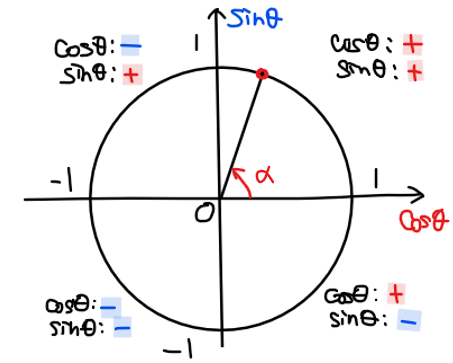
続いて、三角関数の相互関係 \(\small \displaystyle \tan\theta = \frac{\sin\theta}{\cos\theta}\)に\(\small \cos\theta ,\sin\theta\)の値を代入することで、
\begin{split}
&\small \displaystyle \tan\theta = \frac{-\dfrac{4}{5}}{-\dfrac{3}{5}}\\
\small ∴ \space &\small \displaystyle \color{red}{\tan\theta= \frac{4}{3} \quad \cdots 【答】}\\
\end{split}
一般に
$$\small \cos\theta =\frac{x座標\space \space\space }{\space 斜辺\space\space}$$
であり、第3象限ではx座標が負であることから、問題の\(\small \displaystyle \cos\theta=-\frac{3}{5} \)は
$$\small \cos\theta =\frac{-3 }{5}$$
と捉えることができます。
そのうえで、単位円上に\(\small \displaystyle \cos\theta=-\frac{3}{5} \)を図示すると以下のようになります。
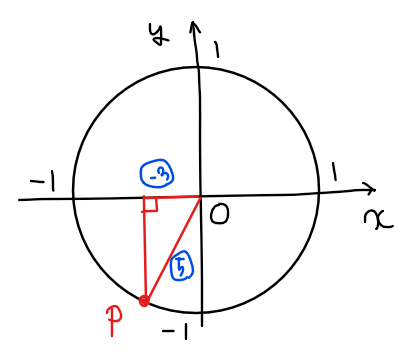
赤丸の点\(\small \mathrm{P}\)が\(\small \displaystyle \cos\theta=-\frac{3}{5} \)となる位置です。
そして、青色で辺の比を記入しています。ただし、普通の辺の比と違って、座標が負のときは辺の比も負にします。今回であれば、\(\small \displaystyle \cos\theta=\frac{-3}{5} \)なので、斜辺の辺の比は「5」、x座標の辺の比は「-3」となります。
この図がかければ、あとは三平方の定理で残りの辺の比(y座標の辺の比)を求めてあげれば、3辺の辺の比が分かります。
実際に計算してみると、y座標の辺(縦の辺)は、\(\small \sqrt{5^2-3^2}=4\)となり、y座標の符号が負であることを加味すると、「-4」となります。
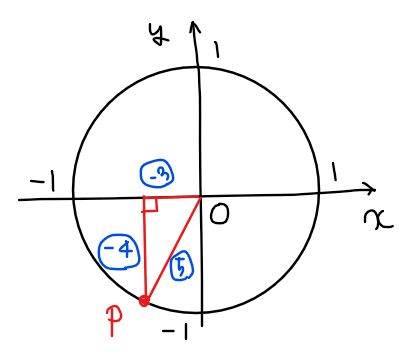
あとは上記の単位円の辺の比を見ながら三角比の定義にあてはめることで
・\(\small \displaystyle \sin\theta = \frac{-4}{5}\) …【答】
・\(\small \displaystyle \tan\theta = \frac{-4}{-3}=\frac{4}{3}\) …【答】
と求めることができます。
【問題2】三角関数の相互関係の利用|tanθの値からsinθ・cosθを求める問題
三角関数の相互関係 \(\small \displaystyle 1+\tan^2\theta = \frac{1}{\cos^2\theta}\)に\(\small \tan\theta =-4\)を代入すると
\begin{split}
&\small \displaystyle 1+(-4)^2= \frac{1}{\cos^2\theta}\\
\small \Leftrightarrow \space &\small \displaystyle \cos^2\theta= \frac{1}{17}\\
\small \Leftrightarrow \space &\small \displaystyle \cos\theta = \pm \frac{1}{\sqrt{17}}\\
\end{split}
\(\small \displaystyle \frac{3}{2}\pi < \theta <2\pi\)の範囲では、\(\small \cos\theta >0\)なので、
\begin{split}
&\small \displaystyle \color{red}{\cos\theta = \frac{1}{\sqrt{17}}\quad \cdots 【答】}\\
\end{split}
また、\(\small \sin^2\theta + \cos^2\theta =1\)より
\begin{split}
&\small\displaystyle \sin^2\theta + \left(\frac{1}{\sqrt{17}}\right)^2= 1\\
\small \Leftrightarrow \space &\small \displaystyle \sin^2\theta = \frac{16}{17}\\
\small \Leftrightarrow \space &\small \displaystyle \sin\theta = \pm \frac{4}{\sqrt{17}}\\
\end{split}
\(\small \displaystyle \frac{3}{2}\pi < \theta <2\pi\)の範囲では、\(\small \sin\theta <0\)なので、
\begin{split}
&\small \displaystyle \color{red}{\sin\theta = -\frac{4}{\sqrt{17}}\quad \cdots 【答】}\\
\end{split}
第4象限(右下)の角で、\(\small \displaystyle \tan\theta =\frac{yの値\space\space\space}{xの値 \space\space\space}\)であることから、
$$ \small \displaystyle \tan\theta =-4=\frac{-4}{1}$$
のように捉えると、考える直角三角形の各辺の比は下図のようになります。
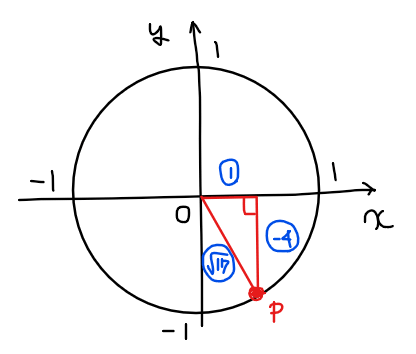
あとは三角関数の定義式にあてはめれば、答えになります。
まとめ|三角関数の相互関係は「単位円」とセットで理解しよう
今回は三角関数の相互関係としてsinθ・cosθ・tanθの関係式が成り立つ理由について解説しました。
一見すると複雑な関係式に感じますが、いずれの関係式も単位円と三角関数の定義を理解していれば、三平方の定理やtanθの定義式をただ言い換えただけの式だと理解することができ、覚えやすくなります。
三角関数は数学の分野の中でも関係式の数が多いので、単なる暗記ではなく、今回のように式の導き方やこれまでに学習した式と紐づけて理解することで覚える量を減らすことができます。
今回扱った三角関数の相互関係は、この後の三角関数の計算や方程式・不等式でも繰り返し使う重要な内容です。ぜひ、公式を覚えるだけでなく、自分で式を導ける状態を目指してみてください。
高校数学の参考書の選び方|独学・先取り学習に最適なおすすめ教材を徹底解説
今回は以上です。お疲れ様でした!

コメント