
三角関数って出てくる公式が多すぎて、何をどこから覚えたらいいのか迷っていませんか?
そんな人向けに、この記事では、三角関数の公式一覧と効率的な覚え方のコツを徹底解説します。
こんな人におすすめ
✓ 三角関数に出てくる公式を確認したい人
✓ 三角関数の公式の中で覚えるべき公式と覚えなくてよい公式を知りたい人
✓ 効率的な覚え方のコツを知りたい人
高校数学の勉強のコツ、日常生活に潜む数学をゆる~く解説した
note記事も更新中!
ぺんきち|公式×思考法で数学力を最大化
数学 / 理科(物理・化学・生物・地学)



三角関数の公式まとめ
三角関数の公式一覧
まずはじめに三角関数に出てくる公式を単元ごとにまとめています。
覚えられていない公式がないかをチェックしてみましょう。
三角関数の関係式
✓ 三角関数の関係式
・\(\small \sin^2\theta +\cos^2\theta =1\)
・\(\small \displaystyle \tan\theta = \frac{\sin\theta}{\cos\theta}\)
・\(\small \displaystyle 1+ \tan^2 \theta = \frac{1}{\cos^2 \theta}\)
三角関数の変換公式
✓ \(\small \theta+2n\pi\) の変換公式
・\(\small \sin(\theta+2n\pi)=\sin\theta\)
・\(\small \cos(\theta+2n\pi)=\cos\theta\)
・\(\small \tan(\theta+2n\pi)=\tan\theta\)
✓ \(\small -\theta\) の変換公式
・\(\small \sin(-\theta)=-\sin\theta\)
・\(\small \cos(-\theta)=\cos\theta\)
・\(\small \tan(-\theta)=-\tan\theta\)
✓ \(\small \pi \pm \theta\) の変換公式
・\(\small \sin(\pi\pm\theta)=\mp\sin\theta\)
・\(\small \cos(\pi\pm\theta)=-\cos\theta\)
・\(\small \tan(\pi\pm\theta)=\pm\tan\theta\)
✓ \(\small \displaystyle \frac{\pi}{2}\pm \theta\) の変換公式
・\(\small \displaystyle \sin\left( \frac{\pi}{2}\pm\theta \right)=\cos\theta\)
・\(\small \displaystyle \cos\left(\frac{\pi}{2}\pm\theta\right)=\mp\sin\theta\)
・\(\small \displaystyle \tan\left(\frac{\pi}{2}\pm\theta\right)=\mp\frac{1}{\tan\theta}\)
三角関数の加法定理
✓ 加法定理
・ \(\small \sin(\alpha+\beta)= \sin\alpha\cos\beta+\cos\alpha\sin\beta\)
・ \(\small \sin(\alpha-\beta)= \sin\alpha\cos\beta-\cos\alpha\sin\beta\)
・ \(\small \cos(\alpha+\beta)= \cos\alpha\cos\beta-\sin\alpha\sin\beta\)
・ \(\small \cos(\alpha-\beta)= \cos\alpha\cos\beta+\sin\alpha\sin\beta\)
・ \(\small \displaystyle \tan(\alpha+\beta)= \frac{\tan\alpha+\tan\beta}{1-\tan\alpha\tan\beta}\)
・ \(\small \displaystyle \tan(\alpha-\beta)= \frac{\tan\alpha-\tan\beta}{1+\tan\alpha\tan\beta}\)
2倍角・3倍角・半角の公式
✓ 2倍角の公式
・\(\small \sin2\theta=2\sin\theta\cos\theta\)
・\(\small \cos2\theta =2\cos^2\theta-1\)
\(\small \cos2\theta =1-2\sin^2\theta\)
・\(\small \displaystyle \tan2\theta=\frac{2\tan\theta}{1-\tan^2\theta}\)
✓ 3倍角の公式
・\(\small \sin3\theta=3\sin\theta-4\sin^3\theta\)
・\(\small \cos3\theta=-3\cos\theta+4\cos^3\theta\)
✓ 半角の公式
・\(\small \displaystyle \sin^2\frac{\theta}{2}=\frac{1-\cos\theta}{2}\)
・\(\small \displaystyle \cos^2\frac{\theta}{2}=\frac{1+\cos\theta}{2}\)
・\(\small \displaystyle \tan^2\frac{\theta}{2}=\frac{1-\cos\theta}{1+\cos\theta}\)
積和・和積の公式
✓ 積和の公式
・\(\small \displaystyle \sin\alpha\cos\beta=\frac{1}{2}\{\sin(\alpha+\beta)+\sin(\alpha-\beta)\}\)
・\(\small \displaystyle \cos\alpha\sin\beta=\frac{1}{2}\{\sin(\alpha+\beta)-\sin(\alpha-\beta)\}\)
・\(\small \displaystyle \cos\alpha\cos\beta=\frac{1}{2}\{\cos(\alpha+\beta)+\cos(\alpha-\beta)\}\)
・\(\small \displaystyle \sin\alpha\sin\beta=-\frac{1}{2}\{\cos(\alpha+\beta)-\cos(\alpha-\beta)\}\)
✓ 和積の公式
・\(\small \displaystyle \sin A+\sin B=2\sin\frac{A+B}{2}\cos\frac{A-B}{2}\)
・\(\small \displaystyle \sin A-\sin B=2\cos\frac{A+B}{2}\sin\frac{A-B}{2}\)
・\(\small \displaystyle \cos A+\cos B=2\cos\frac{A+B}{2}\cos\frac{A-B}{2}\)
・\(\small \displaystyle \cos A-\cos B=-2\sin\frac{A+B}{2}\sin\frac{A-B}{2}\)
三角関数の合成公式
✓ 三角関数の合成公式
\(\small a \neq 0\)または、\(\small b \neq 0\)として $$\small a\sin\theta+b\cos\theta=\sqrt{a^2+b^2}\sin(\theta+\alpha)$$ ただし、\(\small \displaystyle \sin\alpha=\frac{b}{\sqrt{a^2+b^2}}\)、\(\small \displaystyle \cos\alpha=\frac{a}{\sqrt{a^2+b^2}}\)

三角関数の公式の意味と覚え方のコツ
ここからは具体的な公式ごとに公式の意味と覚え方のコツを確認していきます。
一緒に、苦手な公式を克服していきましょう!
三角関数の関係式
✓ 三角関数の関係式
・\(\small \sin^2\theta +\cos^2\theta =1\)
・\(\small \displaystyle \tan\theta = \frac{\sin\theta}{\cos\theta}\)
・\(\small \displaystyle 1+ \tan^2 \theta = \frac{1}{\cos^2 \theta}\)
📌 公式の意味
sin・cos・tanの関係性を表す公式です。
sinからcosやtanの値を求めたり、sin・cosが含まれる式を
sinだけに統一したいときなどに使います。
📌 公式の覚え方のコツ
三角関数の土台となる重要な公式です。
公式自体は、三角関数の定義から意外と簡単に導出ができます。
ただ、使用頻度も高い公式なので覚えておくのがよいと思います。
問題を解くときにたくさん出てくるので、自然と覚えられると思います。
詳しくは別記事で解説しているのでここでは概要だけ解説しますが、
覚え方のコツは単位円をかくことです。
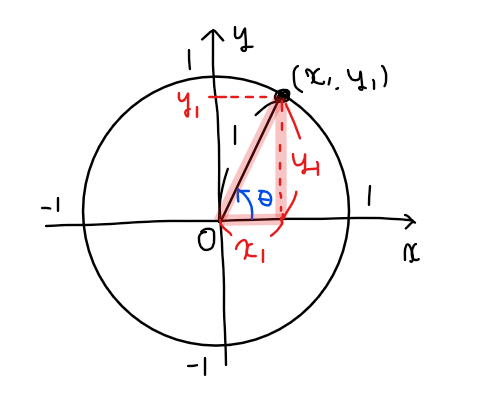
単位円上では、斜辺が1なので\(\small \cos\theta =x\)座標、\(\small \sin\theta =y\)座標になります。
この感覚が超重要!
例えば、1つ目の式
$$\small \sin^2\theta +\cos^2\theta =1$$
は、\(\small \cos\theta =x_1\)、\(\small \sin\theta =y_1\)であることを踏まえると
$$\small (x_1)^2 +(y_1)^2 =1$$
となり、斜辺が1の三平方の定理を言い換えただけの式だということが分かります。
このような感じで他の2式についても導出ができます。
三角関数の変換公式
変換公式については、数も多いのでここではポイントに絞って解説します。
より深く知りたい人は、別記事で解説していますので、よければ確認してみてください~!
\(\small \theta+2n\pi\)の変換公式
✓ \(\small \theta+2n\pi\) の変換公式
・\(\small \sin(\theta+2n\pi)=\sin\theta\)
・\(\small \cos(\theta+2n\pi)=\cos\theta\)
・\(\small \tan(\theta+2n\pi)=\tan\theta\)
📌 公式の意味
三角関数の角度を \(\small \theta+2n\pi\)から\(\small \theta\)に変換する公式です。
この公式は、\(\small 2n\pi\)が単位円\(\small n\)周分を表していることを踏まえると
\(\small n\)周しても三角関数の値は変わらないということを意味しています。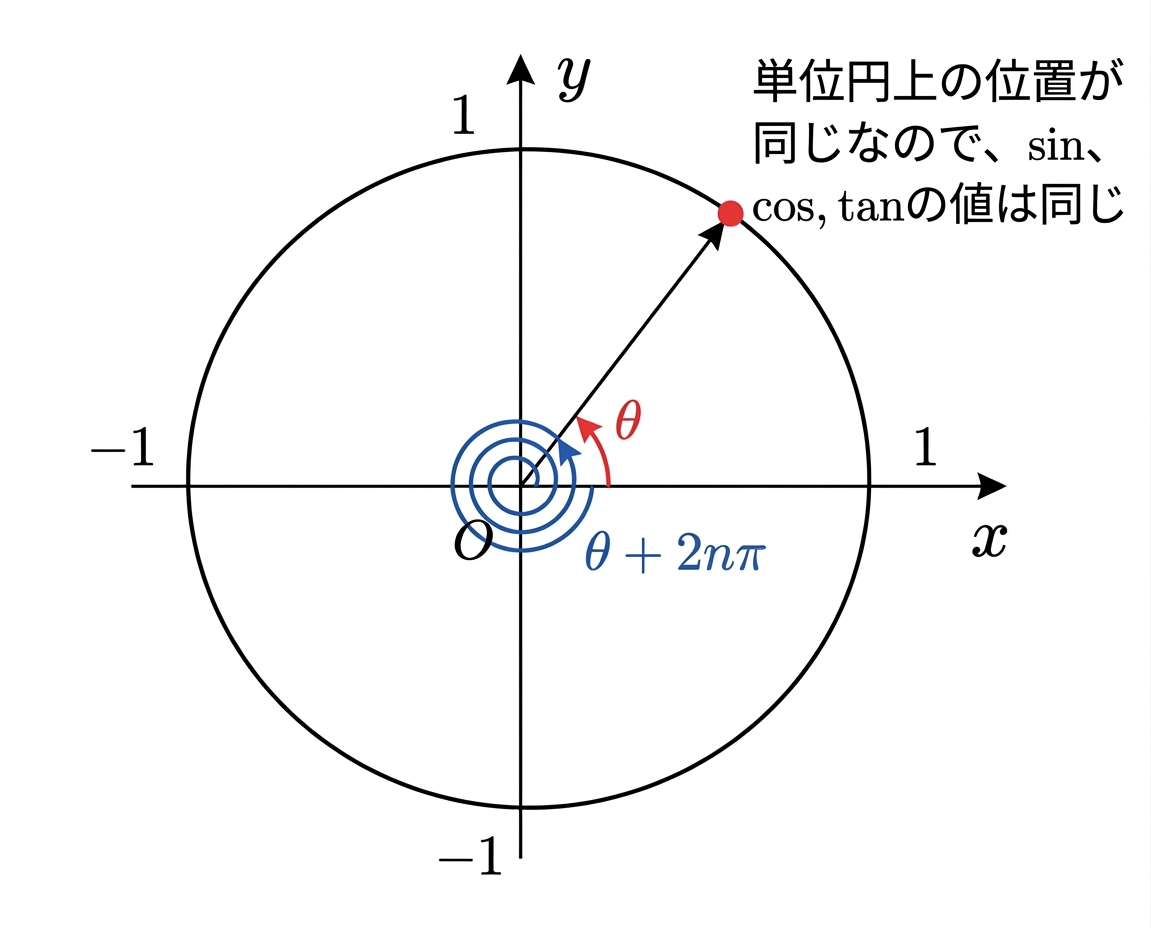
単位円をイメージしてあげれば理解しやすい!
【補足】
ついでに補足すると、\(\small n\)周して関数が同じ値になることを周期性と言います。
三角関数は代表的な周期関数です。
📌 公式の覚え方のコツ
・単位円上の位置が同じ=sin・cos・tanの値は同じ
・\(\small 2n\pi\)は単位円上の\(\small n\)周を表す
ということを理解しておきましょう。
そうすれば暗記せずとも自然に理解できると思います。
\(\small -\theta\) の変換公式
✓ \(\small -\theta\) の変換公式
・\(\small \sin(-\theta)=-\sin\theta\)
・\(\small \cos(-\theta)=\cos\theta\)
・\(\small \tan(-\theta)=-\tan\theta\)
📌 公式の意味
三角関数の角度を \(\small -\theta\)から\(\small \theta\)に変換する公式です。
これは、\(\small \theta\)と\(\small -\theta\)の位置におけるsin、cos、tanの関係性を表している公式と言えます。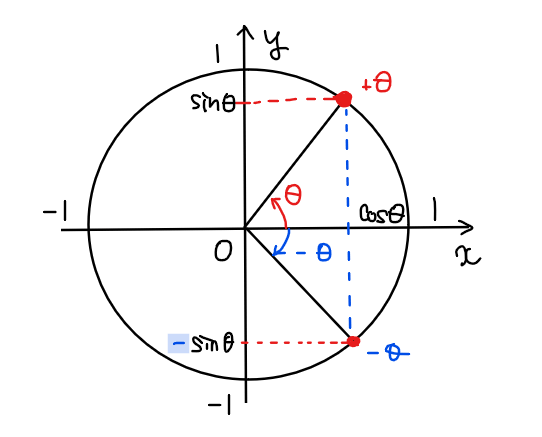
📌 公式の覚え方のコツ
これも単位円で考えると理解しやすくなります。
図からもわかるとおり\(\small \theta\)と\(\small -\theta\)の位置関係は\(\small x\)軸対称になります。
つまり、cos(\(\small x\)座標)の値は変わらず、sin(\(\small y\)座標)の値だけ符号が逆転します。
tanの値は\(\small \displaystyle \tan\theta = \frac{\sin\theta}{\cos\theta}\)の関係式からsinの符号だけが変わるので、tanの符号も変わることがすぐわかります。
このように覚えておくと、自然に公式を導出できるのでおすすめです。
\(\small \pi \pm \theta\)の変換公式
✓ \(\small \pi \pm \theta\) の変換公式
・\(\small \sin(\pi\pm\theta)=\mp\sin\theta\)
・\(\small \cos(\pi\pm\theta)=-\cos\theta\)
・\(\small \tan(\pi\pm\theta)=\pm\tan\theta\)
【補足】
最初は少し分かりにくいかもしれないですが…
公式の両辺にある「\(\small \pm\)」と「\(\small \mp\)」の符号は上同士と下同士で見ます。
例えば…
\(\small \sin(\pi\pm\theta)=\mp\sin\theta\)であれば
・\(\small \sin(\pi+\theta)=-\sin\theta\) ◀上同士
・\(\small \sin(\pi-\theta)=\sin\theta\) ◀下同士
をまとめて表しています。
\(\small \cos(\pi\pm\theta)=-\cos\theta\)であれば
・\(\small \cos(\pi+\theta)=-\cos\theta\)
・\(\small \cos(\pi-\theta)=-\cos\theta\) ※右辺はどちらも「\(\small -\)」で共通
をまとめて表しています。
📌 公式の意味
三角関数の角度を \(\small \pi \pm \theta\)から\(\small \theta\)に変換する公式です。
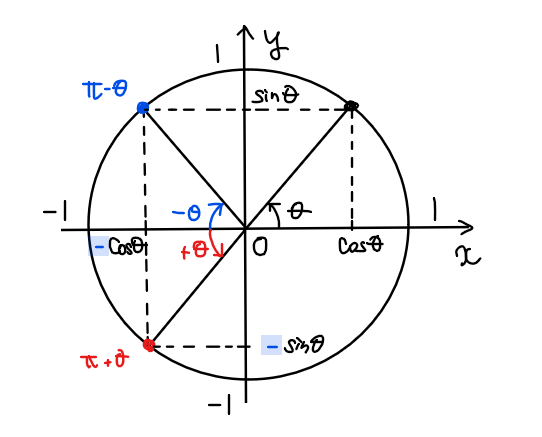
角度 \(\small \pi\)を基準に、\(\small +\theta\)(反時計回りに\(\small \theta\))進んだ位置が\(\small \pi + \theta\)、
逆に\(\small -\theta\)(時計回りに\(\small \theta\))進んだ位置が\(\small \pi – \theta\)になります。
つまり、これらの位置と\(\small \theta\)の位置でのsin、cos、tanの関係性を表した公式が\(\small \pi \pm \theta\)の変換公式というわけです。
📌 公式の覚え方のコツ
これも単位円を用いた求め方を理解しておけば公式の暗記が不要になります。
例えば、\(\small \sin(\pi+\theta)\)であれば、\(\small \pi+\theta\)の位置(赤丸)と\(\small \theta\)の位置(黒丸)のsinの値(\(\small y\)座標)を比較します。
すると、符号が逆転しているだけなので、\(\small \sin(\pi+\theta)=-\sin\theta\)のように、公式が成り立つことが確認できます。
また、このあと紹介する加法定理を使うとより簡単に確認することができます。
例:\(\small \sin(\pi-\theta)\)の場合
\begin{split}
\small \sin(\pi-\theta) &\small = \sin\pi\cos\theta-\cos\pi\sin\theta\\
&\small = 0-(-1)\cdot \sin\theta \space ◀\sin\pi = 0\\
&\small =\sin\theta\\
\end{split}
三角関数の変換公式には、\(\small \displaystyle \frac{\pi}{2}\pm\theta\)や\(\small \theta \pm \pi\)などいろいろなバリエーションがあるので、加法定理で導出するのがおすすめです。
\(\small \displaystyle \frac{\pi}{2}\pm\theta\)の変換公式
✓ \(\small \displaystyle \frac{\pi}{2}\pm \theta\) の変換公式
・\(\small \displaystyle \sin\left( \frac{\pi}{2}\pm\theta \right)=\cos\theta\)
・\(\small \displaystyle \cos\left(\frac{\pi}{2}\pm\theta\right)=\mp\sin\theta\)
・\(\small \displaystyle \tan\left(\frac{\pi}{2}\pm\theta\right)=\mp\frac{1}{\tan\theta}\)
📌 公式の意味
三角関数の角度を \(\small \displaystyle \frac{\pi}{2}\pm \theta\)から\(\small \theta\)に変換する公式です。
これまで同様に90°(\(\small y\)軸)を基準に\(\small \pm\theta\)した位置の三角関数と
\(\small \theta\)の三角関数の関係性を表す公式です。
📌 公式の覚え方のコツ
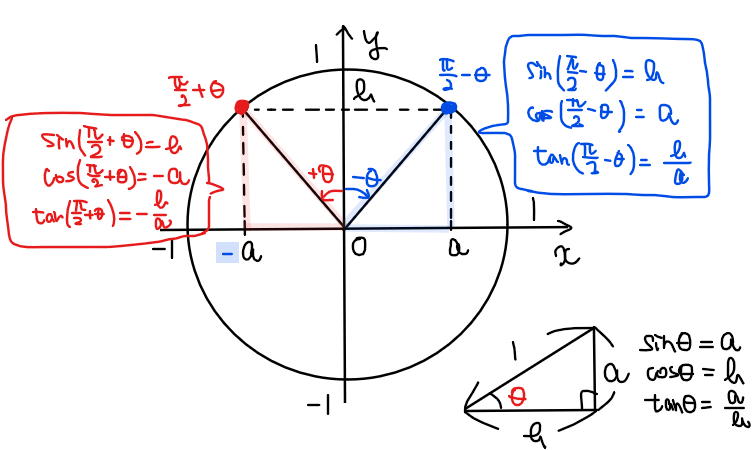
単位円で図示すると上図のようになりますが、\(\small -\theta \)や\(\small \pi \pm \theta\)などの変換公式と違って少し複雑になるので詳細は割愛しますが、三角関数の定義を使いながらsin・cos、tanの値を比較していくと、公式を導くことができます。
90°回転していると単位円で考えるのが難しいので、
このあと出てくる加法定理を使って導出するのが圧倒的に簡単です。

三角関数の加法定理
✓ 加法定理
・ \(\small \sin(\alpha+\beta)= \sin\alpha\cos\beta+\cos\alpha\sin\beta\)
・ \(\small \sin(\alpha-\beta)= \sin\alpha\cos\beta-\cos\alpha\sin\beta\)
・ \(\small \cos(\alpha+\beta)= \cos\alpha\cos\beta-\sin\alpha\sin\beta\)
・ \(\small \cos(\alpha-\beta)= \cos\alpha\cos\beta+\sin\alpha\sin\beta\)
・ \(\small \displaystyle \tan(\alpha+\beta)= \frac{\tan\alpha+\tan\beta}{1-\tan\alpha\tan\beta}\)
・ \(\small \displaystyle \tan(\alpha-\beta)= \frac{\tan\alpha-\tan\beta}{1+\tan\alpha\tan\beta}\)
📌 公式の意味
加法定理は、2つの角 \(\small \alpha, \space \beta\)のsin・cos・tanの値が分かっている場合に
2つの角の和や差のsin・cos・tanの値を求める公式です。
📌 公式の覚え方のコツ
✓ 加法定理の語呂合わせ
・\(\small \sin(\alpha\color{darkorange}{+}\beta)= \color{red}{\sin}\alpha\color{blue}{\cos}\beta\color{darkorange}{+}\color{blue}{\cos}\alpha \color{red}{\sin}\beta\)
咲いたコスモス、コスモス咲いた
※符号は括弧内と同じ
・\(\small \cos(\alpha\color{darkorange}{+}\beta)= \color{blue}{\cos}\alpha\color{blue}{\cos}\beta\color{darkorange}{-}\color{red}{\sin}\alpha\color{red}{\sin}\beta\)
コスモスコスモス、咲いた咲いた
※符号は括弧内と逆
・\(\small \displaystyle \tan(\alpha+\beta)= \frac{\color{blue}{\tan\alpha}\color{dearkorange}{+}\color{red}{\tan\beta}}{1-\color{blue}{\tan\alpha}\color{red}{\tan\beta}}\)
1引くタンタン、タン、タ、タン
※後半の「タン、タ、タン」が分子になることに注意
※リズムで覚える
2倍角の公式・3倍角の公式・半角の公式
✓ 2倍角の公式
・\(\small \sin2\theta=2\sin\theta\cos\theta\)
・\(\small \cos2\theta =2\cos^2\theta-1\)
\(\small \cos2\theta =1-2\sin^2\theta\)
・\(\small \displaystyle \tan2\theta=\frac{2\tan\theta}{1-\tan^2\theta}\)
✓ 3倍角の公式
・\(\small \sin3\theta=3\sin\theta-4\sin^3\theta\)
・\(\small \cos3\theta=-3\cos\theta+4\cos^3\theta\)
✓ 半角の公式
・\(\small \displaystyle \sin^2\frac{\theta}{2}=\frac{1-\cos\theta}{2}\)
・\(\small \displaystyle \cos^2\frac{\theta}{2}=\frac{1+\cos\theta}{2}\)
・\(\small \displaystyle \tan^2\frac{\theta}{2}=\frac{1-\cos\theta}{1+\cos\theta}\)
📌 公式の意味
角度を2倍や3倍、半分にしたときのsin・cos・tanの値を求めることができます。
📌 公式の覚え方のコツ
2倍角の公式は、加法定理において2角 \(\small \alpha, \space \beta\)を同じ角度にした公式だと覚えておけば暗記不要です。
たとえば、加法定理で\(\small \alpha = \beta\)とすれば
\begin{split}
&\small \sin(\alpha +\beta)=\sin\alpha\cos\beta+\cos\alpha\sin\beta\\
\small → \space &\small \sin(\alpha +\color{#ff0055}{\alpha})=\sin\alpha\cos\color{#ff0055}{\alpha}+\cos\alpha\sin\color{#ff0055}{\alpha}\\
\small \Leftrightarrow \space &\small \sin2\alpha=2\sin\alpha\cos\alpha\\
\end{split}
のように簡単に公式を導出できます。
そのうえで、2倍角の公式は利用頻度も多いのでできれば覚えておいた方が素早く問題を解けます。
3倍角の公式も同様に加法定理において、\(\small 2\alpha\), \(\small \alpha\)の和と考えれば導くことができます。
3倍角の公式は利用頻度は低いので出てきたら導出できるようにしておけばよいでしょう。
半角の公式は2倍角の公式を少し変形することで導出できるので
自力で導出できるようにしておけばOKです。
積和・和積の公式
✓ 積和の公式 積を和に直す公式だよっ
・\(\small \displaystyle \sin\alpha\cos\beta=\frac{1}{2}\{\sin(\alpha+\beta)+\sin(\alpha-\beta)\}\)
・\(\small \displaystyle \cos\alpha\sin\beta=\frac{1}{2}\{\sin(\alpha+\beta)-\sin(\alpha-\beta)\}\)
・\(\small \displaystyle \cos\alpha\cos\beta=\frac{1}{2}\{\cos(\alpha+\beta)+\cos(\alpha-\beta)\}\)
・\(\small \displaystyle \sin\alpha\sin\beta=-\frac{1}{2}\{\cos(\alpha+\beta)-\cos(\alpha-\beta)\}\)
✓ 和積の公式 和を積に直す公式だよっ
・\(\small \displaystyle \sin A+\sin B=2\sin\frac{A+B}{2}\cos\frac{A-B}{2}\)
・\(\small \displaystyle \sin A-\sin B=2\cos\frac{A+B}{2}\sin\frac{A-B}{2}\)
・\(\small \displaystyle \cos A+\cos B=2\cos\frac{A+B}{2}\cos\frac{A-B}{2}\)
・\(\small \displaystyle \cos A-\cos B=-2\sin\frac{A+B}{2}\sin\frac{A-B}{2}\)
📌 公式の意味
sin・cosの積をsin・cosの和に直す公式が積和の公式です。
逆にsin・cosの和をsin・cosの積に直す公式が和積の公式です。
積和や和積の公式は難関大の三角関数の等式証明や数Ⅲの積分の応用問題でたまに出てくる程度なので、利用頻度は低いです。
📌 公式の覚え方のコツ
公式自体は、どちらも加法定理から導出できるので、導出方法を理解しておけば十分でしょう。
● 積和の公式
例えば、積和の公式 \(\small \sin\alpha\cos\beta\)であれば、加法定理の公式を思い浮かべたときに「 \(\small \sin\alpha\cos\beta\) 」の項が出てくる
・ \(\small \sin(\alpha+\beta)= \sin\alpha\cos\beta+\cos\alpha\sin\beta\)
・ \(\small \sin(\alpha-\beta)= \sin\alpha\cos\beta-\cos\alpha\sin\beta\)
の公式を足し算すると、右辺の2項目がうまく消えて
\(\small \displaystyle \sin(\alpha+\beta)+\sin(\alpha-\beta)=2\sin\alpha\cos\beta\)
となるので、両辺を2で割れば
\(\small \displaystyle \sin\alpha\cos\beta = \frac{1}{2}\{\sin(\alpha+\beta)+\sin(\alpha-\beta)\}\)
のように導くことができます。
他の公式も同様に求められるよ!
このように、加法定理のどの式を足し引きすれば求めたいsin・cosの積の項が得られるかを判断できるようになることがポイントです。
● 和積の公式
加法定理の公式で
\(\small \alpha+\beta =A\) …①,
\(\small \alpha-\beta =B\) …②
とおきます。ここが最大のポイント!
すると
\(\small \displaystyle \alpha = \frac{A+B}{2}\) …③,
\(\small \displaystyle \beta = \frac{A-B}{2}\) …④
となるので、①~④を積和の公式に代入すれば和積の公式になります。
例えば、
・\(\small \displaystyle \sin\alpha\cos\beta=\frac{1}{2}\{\sin(\alpha+\beta)+\sin(\alpha-\beta)\}\)
の加法定理の公式に①~④を代入すると
\begin{split}
&\small \displaystyle \sin\frac{A+B}{2}\cos\frac{A-B}{2}=\frac{1}{2}\{\sin A+\sin B\}\\
\small \Leftrightarrow \space &\small \displaystyle \sin A+\sin B=2\sin\frac{A+B}{2}\cos\frac{A-B}{2}\\
\end{split}
他の公式も同様に①~④を代入することで簡単に導出できます。
なので、覚えるべきは①、②の\(\small A, B\)の置き方です。
\(\small A = \)角の和、\(\small B = \)角の差と覚えるのがおすすめです。
三角関数の合成公式
✓ 三角関数の合成公式
\(\small a \neq 0\)または、\(\small b \neq 0\)として $$\small a\sin\theta+b\cos\theta=\sqrt{a^2+b^2}\sin(\theta+\alpha)$$ ただし、\(\small \displaystyle \sin\alpha=\frac{b}{\sqrt{a^2+b^2}}\)、\(\small \displaystyle \cos\alpha=\frac{a}{\sqrt{a^2+b^2}}\)
📌 公式の意味
sinとcosの和を1つにまとめるときに使うのが三角関数の合成公式です。
三角方程式や三角不等式などでよく使う公式になります。
📌 公式の覚え方のコツ
三角関数の合成公式は公式自体を丸暗記しただけでは
実際の問題を解くことができません。
そのため公式を覚えるのではなく、具体的な合成の手順を覚えることが重要です。
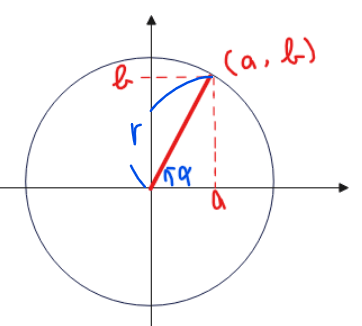
STEP3:『\(\small r\sin(\theta +\alpha)\)』が合成した三角関数。
このような手順で三角関数を1つにまとめることができます。
円を考えて半径と角度を求めるという考え方がポイントになります。

【これだけ覚えろ】三角関数の公式の効率的な覚え方
三角関数が多くの人にとって苦手になりやすい最大の原因が、公式の数が多いからです。
これは裏を返せば、公式を覚えてしまえば三角関数を得意分野にすることができるということです。
と言っても、暗記って大変ですよね…。
そこでこの章では、覚える公式を最小にしてすべての公式を導出できるようにするためには
どの公式を覚えればいいのかを解説していきたいと思います。
三角関数の関係式は土台となる基礎
三角関数の基礎公式です。
sin・cos・tanの値を求めたり式変形で絶対に使う公式なので、
まずは三角関数の関係式を覚えましょう。
3つの式がありますが、まず覚えるのは
・\(\small \sin^2\theta +\cos^2\theta =1\)
・\(\small \displaystyle \tan\theta = \frac{\sin\theta}{\cos\theta}\)
の2つだけでOKです。最後の式はあまり使わない(数Ⅲのtanの積分で出てくるくらい)のと
上記の2式からすぐ導出できるので、最初は覚えなくてよいでしょう。
加法定理は暗記のコスパ最強
加法定理の暗記がコスパ・タイパ最強な理由
加法定理から導ける公式は以下の公式です。
・三角関数の変換公式(\(\small \theta +2n\pi\), \(\small -\theta\), \(\small \pi \pm \theta\), \(\small \displaystyle \frac{\pi}{2} \pm \theta\)など)
・2倍角、3倍角、半角の公式
・和積・積和の公式
ということで、ほとんどの公式が加法定理から導けるわけです(笑)。
なので、頑張って加法定理さえ覚えてしまえば
ほとんどの公式は半分覚えられたといっても過言ではありません。
あとは、加法定理からどのように導けるかを覚えればよいだけです。
こう言われると、加法定理の公式を覚えてやってもいいかもという気になるかも!?
加法定理の暗記はたった2つだけ
さらに、加法定理の公式は全部で6個ありますが、
覚えるべきはそのうちたった2つだけです(゚Д゚;)
具体的には、\(\small \sin(\alpha+\beta)\), \(\small \cos(\alpha+\beta)\)だけ覚えれば、\(\small \tan(\alpha+\beta)\)は
$$\small \displaystyle \tan(\alpha+\beta)=\frac{\sin(\alpha+\beta)}{\cos(\alpha+\beta)}$$
から導出できますし、\(\small \beta\)を\(\small -\beta\)に置き換えることで\(\small \sin(\alpha-\beta)\), \(\small \cos(\alpha-\beta)\)は導出できます。
三角関数の合成公式はやり方を覚えよう
最後は三角関数の合成です。
厳密には合成公式は加法定理を使って導出できますが複雑なので別物扱いしてます(^^;)
三角関数の合成公式の覚え方でも触れましたが、
合成公式は公式自体を暗記するのではなく、合成のやり方を覚えることが大事です。
問題を通して自力で合成できるようになるまで繰り返し演習しましょう。
まとめ|覚えるべき公式は5つだけ
というわけで、ここまでの内容をまとめると、三角関数の公式として覚えるべき公式は次の5つに絞られます。
✓ 三角関数の関係式
・\(\small \sin^2\theta +\cos^2\theta =1\)
・\(\small \displaystyle \tan\theta = \frac{\sin\theta}{\cos\theta}\)
✓ 加法定理
・ \(\small \sin(\alpha+\beta)= \sin\alpha\cos\beta+\cos\alpha\sin\beta\)
・ \(\small \cos(\alpha+\beta)= \cos\alpha\cos\beta-\sin\alpha\sin\beta\)
✓ 三角関数の合成は手順を覚える
\(\small a\sin\theta +b\cos\theta\)の合成は…
・点 \(\small (a,b)\)を円上にプロットして、半径\(\small r\)、角\(\small \alpha\)を求める
・\(\small r\sin(\theta +\alpha)\)が合成した三角関数
最初の公式の数からするとかなり少なくなりました。
まずはこの5つをしっかりと覚えちゃいましょう(もちろん理解もしましょう)。
その後、使っていくうちに自然と覚えられる公式も出てくると思いますし
毎回導出するのが手間だと感じた公式は覚えるのもありでしょう。
自分に合ったコスパ・タイパの良い通信教育サービスを、こちらの記事で分かりやすく解説しています。気になる方はぜひチェックしてみてください。
【数学攻略】部活と両立して偏差値を上げる!通信教育3社(スタサプ・Z会・進研ゼミ)を徹底比較
📌 (参考)三角関数の公式ごとの暗記要否/導出に必要な公式
| ✓ 三角関数の関係式 | |
| (a1) \(\small \sin^2\theta+\cos^2\theta=1\) | ☆覚える |
| (a2) \(\small \displaystyle\tan\theta=\frac{\sin\theta}{\cos\theta}\) | ☆覚える |
| (a3) \(\small \displaystyle1+\tan^2\theta=\frac1{\cos^2\theta}\) | ×暗記不要(a1、a2から導出できる) |
| ✓ \(\small \theta+2n\pi\) の変換公式 | |
| (b1) \(\small \sin(\theta+2n\pi)=\sin\theta\) | △理解しておくべき(加法定理からも導出できる) |
| (b2) \(\small \cos(\theta+2n\pi)=\cos\theta\) | △理解しておくべき(加法定理からも導出できる) |
| (b3) \(\small \tan(\theta+2n\pi)=\tan\theta\) | △理解しておくべき(加法定理からも導出できる) |
| ✓ \(\small -\theta\) の変換公式 | |
| (c1) \(\small \sin(-\theta)=-\sin\theta\) | ×暗記不要(加法定理から導出できる) |
| (c2) \(\small \cos(-\theta)=\cos\theta\) | ×暗記不要(加法定理から導出できる) |
| (c3) \(\small \tan(-\theta)=-\tan\theta\) | ×暗記不要(加法定理から導出できる) |
| ✓ \(\small \pi\pm\theta\) の変換公式 | |
| (d1) \(\small \sin(\pi\pm\theta)=\mp\sin\theta\) | ×暗記不要(加法定理から導出できる) |
| (d2) \(\small \cos(\pi\pm\theta)=-\cos\theta\) | ×暗記不要(加法定理から導出できる) |
| (d3) \(\small \tan(\pi\pm\theta)=\pm\tan\theta\) | ×暗記不要(加法定理から導出できる) |
| ✓ \(\small \displaystyle\frac{\pi}{2}\pm\theta\) の変換公式 | |
| (e1) \(\small \displaystyle\sin\left(\frac{\pi}{2}\pm\theta\right)=\cos\theta\) | ×暗記不要(加法定理から導出できる) |
| (e2) \(\small \displaystyle\cos\left(\frac{\pi}{2}\pm\theta\right)=\mp\sin\theta\) | ×暗記不要(加法定理から導出できる) |
| (e3) \(\small \displaystyle\tan\left(\frac{\pi}{2}\pm\theta\right)=\mp\frac1{\tan\theta}\) | ×暗記不要(加法定理から導出できる) |
| ✓ 加法定理 | |
| (f1) \(\small \sin(\alpha+\beta)=\sin\alpha\cos\beta+\cos\alpha\sin\beta\) | ☆覚える |
| (f2) \(\small \sin(\alpha-\beta)=\sin\alpha\cos\beta-\cos\alpha\sin\beta\) | ×暗記不要(f1を\(\small-\beta\)に置き換えるだけ) |
| (f3) \(\small \cos(\alpha+\beta)=\cos\alpha\cos\beta-\sin\alpha\sin\beta\) | ☆覚える |
| (f4) \(\small \cos(\alpha-\beta)=\cos\alpha\cos\beta+\sin\alpha\sin\beta\) | ×暗記不要(f3を\(\small-\beta\)に置き換えるだけ) |
| (f5) \(\small \displaystyle\tan(\alpha+\beta)=\frac{\tan\alpha+\tan\beta}{1-\tan\alpha\tan\beta}\) | ×暗記不要(f1,f3から導出できる) |
| (f6) \(\small \displaystyle\tan(\alpha-\beta)=\frac{\tan\alpha-\tan\beta}{1+\tan\alpha\tan\beta}\) | ×暗記不要(f5を\(\small-\beta\)に置き換えるだけ) |
| ✓ 2倍角の公式 | |
| (g1) \(\small \sin2\theta=2\sin\theta\cos\theta\) | △よく使うので覚えるのがおすすめ(加法定理f1から導出できる) |
| (g2) \(\small \cos2\theta=2\cos^2\theta-1\) | △よく使うので覚えるのがおすすめ(加法定理f3から導出できる) |
| (g2′) \(\small \cos2\theta=1-2\sin^2\theta\) | △よく使うので覚えるのがおすすめ(加法定理f3から導出できる) |
| (g3) \(\small \displaystyle\tan2\theta=\frac{2\tan\theta}{1-\tan^2\theta}\) | ×暗記不要(f5から導出できる) |
| ✓ 3倍角の公式 | |
| (h1) \(\small \sin3\theta=3\sin\theta-4\sin^3\theta\) | ×暗記不要(加法定理f1と2倍角の公式から導出できる) |
| (h2) \(\small \cos3\theta=-3\cos\theta+4\cos^3\theta\) | ×暗記不要(加法定理f3と2倍角の公式から導出できる) |
| ✓ 半角の公式 | |
| (i1) \(\small \displaystyle\sin^2\frac{\theta}{2}=\frac{1-\cos\theta}{2}\) | ×暗記不要(2倍角の公式g1から導出できる) |
| (i2) \(\small \displaystyle\cos^2\frac{\theta}{2}=\frac{1+\cos\theta}{2}\) | ×暗記不要(2倍角の公式g2から導出できる) |
| (i3) \(\small \displaystyle\tan^2\frac{\theta}{2}=\frac{1-\cos\theta}{1+\cos\theta}\) | ×暗記不要(i1,i2から導出できる) |
| ✓ 積和の公式 | |
| (j1) \(\small \displaystyle\sin\alpha\cos\beta=\frac12\{\sin(\alpha+\beta)+\sin(\alpha-\beta)\}\) | ×暗記不要(加法定理f1,f2から導出できる) |
| (j2) \(\small \displaystyle\cos\alpha\sin\beta=\frac12\{\sin(\alpha+\beta)-\sin(\alpha-\beta)\}\) | ×暗記不要(加法定理f1,f2から導出できる) |
| (j3) \(\small \displaystyle\cos\alpha\cos\beta=\frac12\{\cos(\alpha+\beta)+\cos(\alpha-\beta)\}\) | ×暗記不要(加法定理f3,f4から導出できる) |
| (j4) \(\small \displaystyle\sin\alpha\sin\beta=-\frac12\{\cos(\alpha+\beta)-\cos(\alpha-\beta)\}\) | ×暗記不要(加法定理f3,f4から導出できる) |
| ✓ 和積の公式 | |
| (k1) \(\small \displaystyle\sin A+\sin B=2\sin\frac{A+B}{2}\cos\frac{A-B}{2}\) | ×暗記不要(j1から導出できる) |
| (k2) \(\small \displaystyle\sin A-\sin B=2\cos\frac{A+B}{2}\sin\frac{A-B}{2}\) | ×暗記不要(j2から導出できる) |
| (k3) \(\small \displaystyle\cos A+\cos B=2\cos\frac{A+B}{2}\cos\frac{A-B}{2}\) | ×暗記不要(j3から導出できる) |
| (k4) \(\small \displaystyle\cos A-\cos B=-2\sin\frac{A+B}{2}\sin\frac{A-B}{2}\) | ×暗記不要(j4から導出できる) |
| ✓ 三角関数の合成公式 | |
| (l1) \(\small a\sin\theta+b\cos\theta=\sqrt{a^2+b^2}\sin(\theta+\alpha)\) | ☆覚える(公式自体ではなく手順を覚える) |
まとめ|三角関数は公式で差がつく
今回は三角関数の公式と効率的な覚え方について解説しました。
公式は丸暗記ではなく、理解することが重要です。
しかし、受験ではすべての公式を1から導出していては時間がかかってしまうため
ある程度の暗記が必要なことも事実です。
ただ、すべてを暗記してしまうと、時間が経つと忘れてしまったり
覚えるのに時間がかかったりしてしまうので、暗記はできるだけ少ない数に限定することが重要です。
まずは今回解説した5つの公式を覚えることで、他の公式を自力で導出できるようにしてみてください。
ここが完璧になれば、少ない暗記量で多くの公式を使うことができ、解ける問題の幅が劇的に広がると思います。
高校数学の参考書の選び方|独学・先取り学習に最適なおすすめ教材を徹底解説
今回は以上です。お疲れさまでした!


コメント